Save Our Belper Mills!
The Belper Mill Complex includes a number of globally unique historic features which are separately recognised with their own distinct character.
Derwent Valley Mills World Heritage Site
The Derwent Valley, from the Silk Mill in Derby in the south to Masson Mill in Matlock Bath to the north was inscribed as a UNESCO World Heritage Site in 2001 on the following criteria:
The Derwent Valley saw the birth of the factory system, when new types of building were erected to house the new technology for spinning cotton developed by Richard Arkwright.
In the Derwent Valley for the first time there was large-scale industrial production in a hitherto rural landscape. The need to provide housing and other facilities for workers and managers resulted in the creation of the first modern industrial towns. The fact that the further development of urban-based cotton mill technology happened in Lancashire rather than Derbyshire meant that early mills in the Derwent Valley were not re-developed.
UNESCO
There are just 33 UNESCO World Heritage sites in the whole of the UK.
The Derwent Valley Mills is the only World Heritage site in the East Midlands.
https://whc.unesco.org/en/statesparties/gb

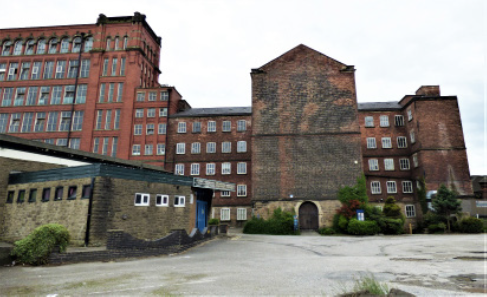
NORTH MILL
1804: GRADE I LISTED
INCORPORATING BELPER MUSEUM & VISITORS CENTRE
Rebuilt on an earlier mill destroyed by fire. It was seminal in the evolution of fire-proof design using iron and brick structure with clay pot infill and plaster finish. It is one of the oldest surviving examples of an industrial iron-framed ‘fire-proof ’ building and is recognised as one of the most important industrial buildings in the world. North Mill is on the Historic England’s Buildings at Risk Register: Priority C – ‘Slow decay: no solution agreed’.
“Apart from Bage’s mill at Shrewsbury (which has an altered exterior) the north mill is the earliest example of a completely iron framed mill in the world and is certainly the most intact extant example of this type of construction”.
The ground and first floor are currently leased to the Belper North Mill Trust (see overleaf). They opened their Belper North Mill Museum and Visitor Centre in 1996. The upper floors are rented out by First Investments as managed office space. A restaurant occupies the adjacent workshop building. The 1965 canteen on the waterside is now empty again, after the soft- play facility closed recently.
CHIMNEY
1854-1990: GRADE II LISTED
At the time, the highest chimney in the country, it was constructed to provide the option of steam power when water levels were too high or too low. The chimney predates the East Mill by half a century. In 1990 reports of the chimny ‘swaying wildly’ in high winds caused the nearby school to be evacuated. The eventual demolition took longer than it did to build. Foundations and substantial base survive.


BELPER RIVER WEIRS, RETAINING WALLS AND SLUICES c.1793
First Listed 1966.
GRADE II* LISTED
All the sluices, the floodgate, and both weirs, East and West of the river bridge (and the retaining walls between them) are included in the listing. Two water channels cross the site passing below the North-East and South-East corners of the East Mill. Two sets of sluice gates which control the flow of water.
The horseshoe weir (or Circular weir as known then) was constructed at the same time as the West Mill, to ensure there was sufficient head to power all the waterwheels on site – there were eleven in all.
The sluices and weir starred in Ken Russell’s tragic drowning scene in the 1969 film ‘Women in Love’.
WEST MILL COMPLEX
Majority completed by 1796 and demolished in total by 1962.
JUBILEE CLOCK TOWER
completed 1898 commemorated Queen Victoria’s Diamond Jubilee.
ROUND MILL completed – 1813
Unique circular shape for an industrial building – used Jeremy Bentham’s 18th century Pantopticon prison model needing only one central overseer to supervise production. Demolition with accompanying fatalities is within living memory (December 19590

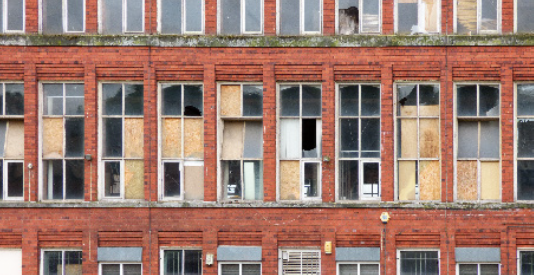
EAST MILL 1912: Grade II Listed
Listed in 1979.
Constructed by the ESCCo, this imposing 7-storey building has a structural steel frame with Accrington brick cladding. Built without scaffolding in the style of the Lancashire mills which post-dated the Derwent Valley innovations. Operations ceased 1986 bringing to an end 210 years of cotton thread production on the site. It is now completely unoccupied and unheated and the ‘north light’ glazed roof construction is allowing water to penetrate through the building.
STRUTT HOUSE
Listed in 1960.
Built at the same time as the East Mill. Strutt House was previously known just as ‘offices’ and was the adminstrative hub of the working mill complex. Details of note include the initials of the ESCCo carved above the entrance and stone cladding which denoted it’s non- manufacturing use. Currently rented out as office space.
TURBINE – CURRENT OPERATION
Listed 1990
Derwent Hydroelectric Power Ltd generate clean electricity using the turbines in the remnants of the largely demolished South Mill. They operate a 350kw scheme fed by the South Mill cut (watercourse) in the same position as the turbines shown on the historic watercourses plan left. The turbine is rated at 350kw which is enough to power 400+ average homes.
ARCHED FOOTBRIDGE
C 1795: GRADE II* LISTED
Listed in 1960.
The oldest surviving structure on the main mill site is the Gangway, the covered stone footway over the main road. Built in 1795, it allowed mill workers to cross from one side of the road to the other without leaving the mill complex. Gunholes were added in 1810, so that the mills could be defended by soldiers in case of an attack by mill-wreckers.
SOUTH MILL
C 1776 : Grade II Listed
Fireproof version rebuilt in the Early 1800s
Demolished in 1962. The single storey turbine house that was part of the South Mill still remains and is included in the listing. Predated surviving North Mill. The original South Mill was Jedidiah Strutt’s first mill in Belper, completed in 1776.